How to Improve Lead Conversion: A Practical Guide for Arizona Businesses
How to Improve Lead Conversion: A Practical Guide for Arizona Businesses
Most Arizona businesses do not have a lead problem. They have a handling problem. Leads arrive through Google, Maps, ads and referrals, and then wait too long for a reply, get one follow-up instead of several, or never get sorted by how likely they are to buy. Improving lead conversion means fixing four things in order: how you measure it, how fast you respond, how you qualify leads, and how consistently you follow up. Arizona Strategy builds this kind of lead handling for local businesses, from conversion-focused websites to automated SMS and email follow-ups.
TL;DR
- Lead conversion rate is customers divided by leads, times 100. Define “lead” and “customer” in writing first, or the number means nothing.
- Speed decides a large share of outcomes: a widely cited study found that odds of reaching a lead fall sharply after the first few minutes.
- Sort leads by fit and urgency so your best hours go to the leads most likely to buy.
- Most sales need several touches. A set follow-up sequence beats one hopeful call.
- Track conversion by source and by month, and compare yourself to your own last quarter, not a generic industry average.
Table of Contents
- What lead conversion means and how to calculate it
- What is a good lead conversion rate?
- Find where leads are leaking
- Respond fast: speed to lead
- Qualify leads so effort goes where it pays
- Follow up in a sequence, not once
- Make the lead source work harder
- Measure, test and improve month by month
- How automation helps a small team
- Where we can help
- Our perspective
- FAQ
- Sources
What lead conversion means and how to calculate it
A lead is anyone who has raised a hand: a form fill, a phone call, a chat message, a quote request. Lead conversion is the step where that person becomes a paying customer. Shopify defines it the same way and gives the rate formula as converted leads divided by total leads, multiplied by 100.
A simple example: your HVAC company receives 100 leads in a month from Google, Maps and ads combined. Twenty become booked and paid jobs. Your lead conversion rate is 20%.
The formula is easy. The discipline is in the definitions:
- What counts as a lead? If marketing counts every form fill, including spam and job applicants, while the owner counts only real buying inquiries, the denominator changes depending on who pulls the report.
- What counts as converted? A paid job, a signed agreement, or a booked appointment? Pick one and stay with it.
- When is it counted? A lead that arrives in October may not buy until December. Measure each month’s leads as a group and see how many of them eventually convert, instead of dividing this month’s sales by this month’s leads.
Write those three answers on one page. It takes ten minutes and prevents months of arguing over numbers.
What is a good lead conversion rate?
There is no single answer, and published benchmarks vary widely because they mix industries, deal sizes and lead sources. A caller who searched “emergency AC repair Mesa” and phoned you is far warmer than someone who downloaded a guide, so the two should never share one average.
The useful benchmark is your own. Split your leads by source (Google Search, Google Maps, paid ads, referrals, website forms, phone calls) and record the rate for each every month. Your goal is to beat last quarter in each source. When one source converts far below the others, you have found where to work first.
Find where leads are leaking
Before changing anything, map the path a lead takes and count how many survive each stage. For a typical local service business it looks like this:
- Lead arrives (call, form, chat, text)
- First response
- Conversation or qualification
- Estimate or proposal
- Booked job or signed contract
Put real numbers beside each stage for the last 90 days. Three patterns show up again and again:
| Where the drop is | What it usually means | First fix |
|---|---|---|
| Leads never get a response | Missed calls, slow replies, forms that go to an unread inbox | Faster response, call tracking, automated first reply |
| Leads respond but never book | Weak qualification or one-and-done follow-up | Scoring and a follow-up sequence |
| Estimates go out but do not close | Pricing, trust or timing issues | Reviews, clearer proposals, timed follow-up |
| Visitors never become leads | Website friction | Clearer offer, shorter form, click-to-call |
The first row is the most common and the cheapest to fix, so start there.
Respond fast: speed to lead
Speed is the single most documented lever in lead handling. A Harvard Business Review study of 2,241 US companies found that the average first response to a web lead took 42 hours, only 37% of companies responded within an hour, and 23% never responded at all.
The same page summarizes the 2007 lead response study analyzed by MIT’s James Oldroyd, covering more than 15,000 leads: the odds of making contact dropped about 100 times when the first call came at 30 minutes instead of within 5 minutes, and the odds of qualifying the lead dropped about 21 times. Those data are older, and your results will differ, but the direction holds for local services: people who are shopping contact several companies and often hire the first one that answers.
How to build speed into your week:
- Route every channel to one place. Calls, forms, chat and texts should land in a single list so nothing sits in a personal inbox.
- Send an instant acknowledgment. An automatic text or email within a minute (“Thanks, we got your request, a technician will call you shortly”) keeps the lead from moving on while you finish a job.
- Set a response standard. For example, every inbound call or form gets a human reply within 5 to 15 minutes during business hours, and a text reply after hours.
- Track missed calls. A missed call that never gets a callback is a lead you paid to acquire and then lost. Our guide on call tracking and speed to lead for East Valley home service companies walks through how to catch them.
Qualify leads so effort goes where it pays
Not every lead deserves the same treatment. Qualification is the quick sorting step that tells you who is ready to buy, who needs time, and who is not a fit (outside your service area, outside your budget range, or just looking for free advice).
For a straightforward local service, four questions are enough:
- What problem are you trying to solve?
- When do you need it done?
- Are you the person who makes the decision?
- Do you have a budget range in mind?
Then sort the answers into three groups:
- Hot: clear problem, near-term timeline, decision-maker. Same-day contact, ideally within minutes.
- Warm: real interest, longer timeline or other decision-makers. Follow up within a day or two and stay on a schedule.
- Cold or not a fit: put into a slower, low-effort nurture list, or politely decline.
You do not need complicated software for this. A simple sheet or CRM (customer relationship management) record with three to five fields, such as source, timeline, job type and city, is enough to sort a pipeline. Our article on how to organize sales leads covers a simple system for this.
Follow up in a sequence, not once
Most buyers do not decide on the first contact, yet many businesses stop after one call or one email. The reasoning is simple: the leads do not vanish, they buy from whoever stays in touch in a useful way.
A sample sequence for a warm lead that you can adapt:
| Day | Touch | Purpose |
|---|---|---|
| 0 | Call plus text | Answer, qualify, book the next step |
| 2 | Recap, confirm what they need, offer times | |
| 5 | Text | Short check-in with a clear question |
| 10 | Something useful: a reviewed project, a common question answered | |
| 21 | Call or text | Light touch, ask if timing has changed |
| 30 | Final message, then long-term nurture | Leave the door open |
Two habits make the sequence work. First, personalize the first and last messages and use templates in the middle, so the workload stays manageable. Second, make missed follow-ups visible: each lead should have a next action and a date, so a stalled lead shows up on a list instead of disappearing.
For timing, cadence and message examples, see how to follow up with leads. If you run a home service shop, the weekly lead follow-up habits for East Valley HVAC and plumbing show what this looks like in a real week.
Make the lead source work harder
Conversion starts before the lead arrives. The channel and the page they land on shape how ready they are to buy.
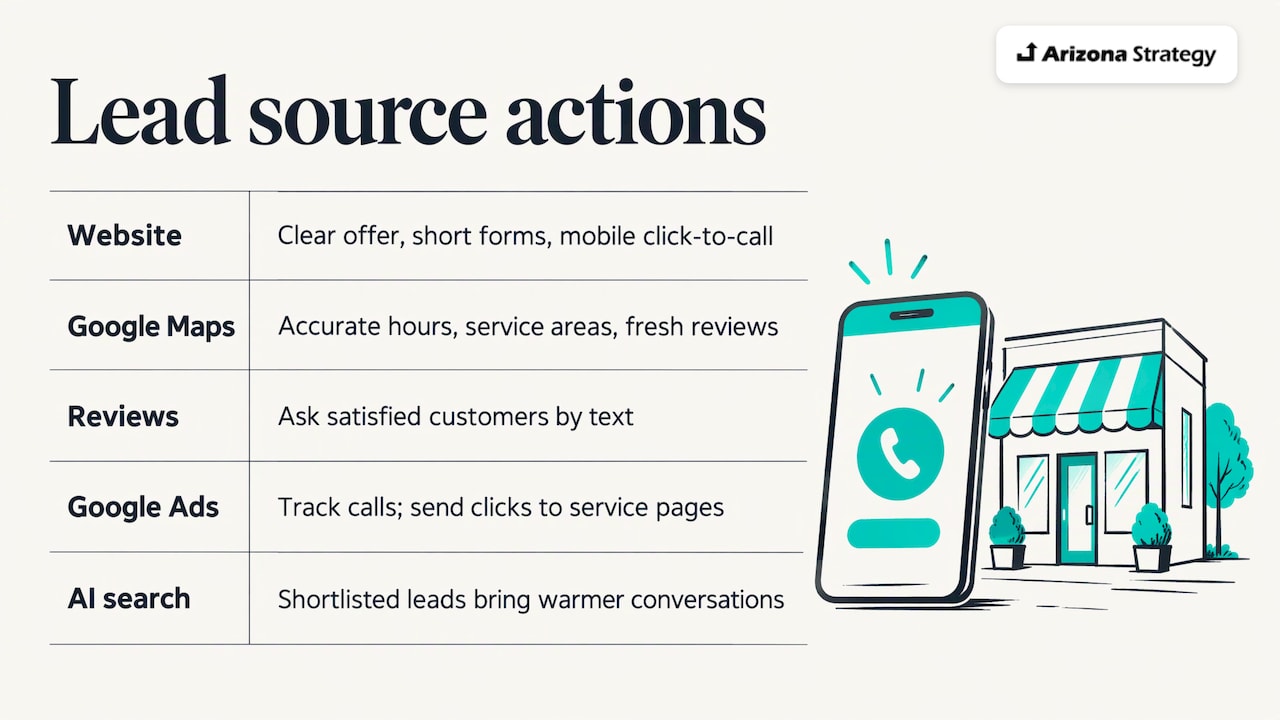
Your website. A visitor who cannot find a phone number, faces a ten-field form or lands on a page that does not match their search will leave. Conversion-focused design means a clear offer above the fold, click-to-call on mobile, short forms and proof (reviews, licenses, project photos) near every call to action. Our team builds this through web design and conversion optimization for Phoenix-area businesses.
Google Maps and your Business Profile. People who find you in the map pack are often ready to call. A complete Google Business Profile, accurate hours, service areas and fresh reviews raise both visibility and the share of viewers who contact you.
Reviews. Reviews work at the moment of decision. A lead comparing three Scottsdale contractors will usually call the one with recent, specific reviews. Asking every satisfied customer right after the job, by text, is the simplest way to keep reviews flowing.
Google Ads. Paid clicks cost money whether or not the call is answered. Send them to a landing page built for one service, track calls and form fills as conversions, and make sure someone answers fast. A fast response multiplies the return on the same ad spend.
AI search. More buyers now ask ChatGPT, Gemini or Perplexity for local recommendations. Being named in those answers brings leads who already have a shortlist, which tends to produce warmer conversations.
Measure, test and improve month by month
Pick a small set of numbers and review them on the same day each month:
- Leads by source
- Response time (median minutes to first reply)
- Lead-to-booked-appointment rate
- Booked-to-paid rate
- Cost per lead by channel
- Average job value
Change one thing at a time. For example, add an instant text reply for 30 days and compare response time and booking rate against the previous 30 days. Then test the follow-up sequence. Changing five things at once leaves you unsure what worked.
Watch for hidden concentration, too. A team-wide rate can look healthy while one person closes most of the deals. If so, the rest of the team’s habits are the opportunity: copy what that person does in the first five minutes and in the follow-up.
How automation helps a small team
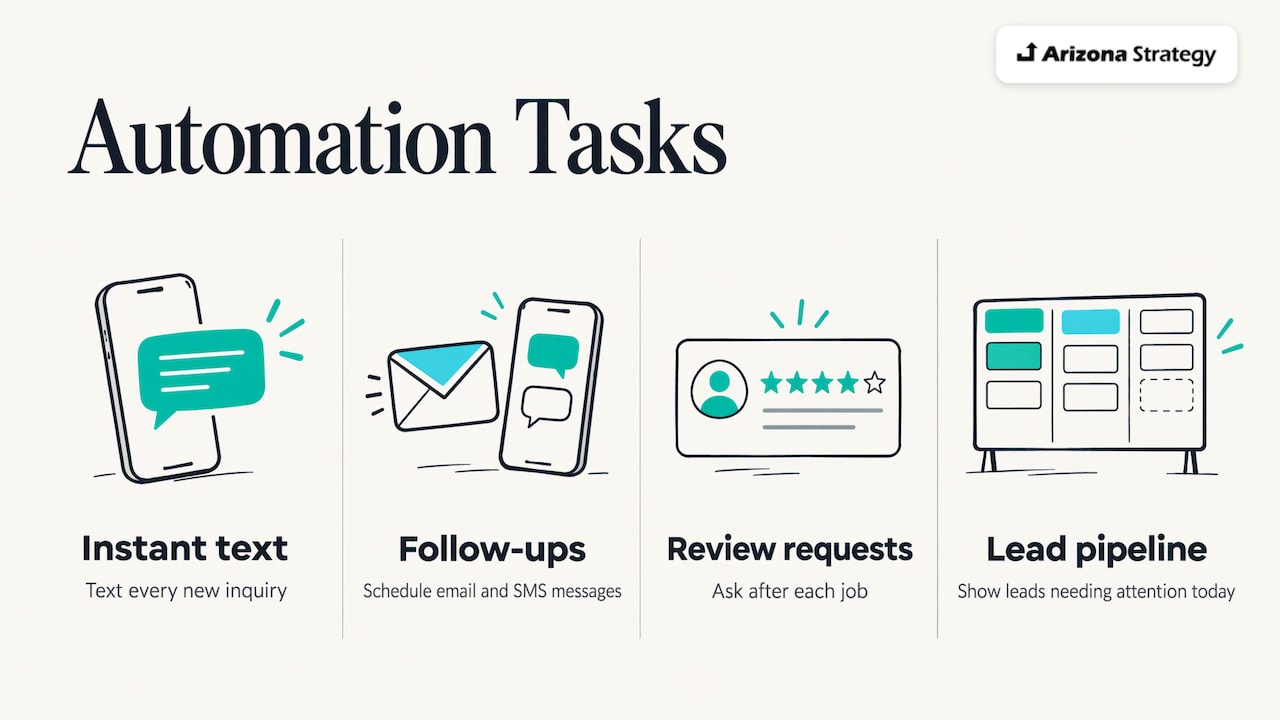
Owners and office managers are busiest exactly when leads arrive: during jobs, on the road, after hours. Automation covers the gaps without adding headcount: an instant text to every new inquiry, scheduled email and SMS follow-ups, review requests after each job, and a pipeline view showing which leads need attention today.
Arizona Strategy offers AI marketing automation at $100 per month, covering intelligent SMS and email follow-ups, AI customer engagement and CRM and lead management tools. Our review growth service, Google Review Growth by RankStream, is built to generate more reviews automatically.
Where we can help
If your numbers show leads leaking at the first response or the follow-up stage, the quickest gains usually come from automation and a better-converting site. We are a Phoenix-based agency serving businesses in Phoenix, Scottsdale, Tempe, Mesa, Chandler and across Arizona. Our work covers local and technical SEO, Google Ads management, web design and conversion optimization, AI search visibility and AI marketing automation, all aimed at qualified leads, booked appointments and paying customers rather than clicks alone.

To see what fits your business, start at Arizona Strategy.
Our perspective
Lead generation and lead conversion are often handled by different people, or by nobody. A business pays for visibility, gets calls and forms, and then judges marketing by a number that depends mostly on what happens after the lead arrives.
That is why we measure outcomes: qualified leads, booked appointments and paying customers. A strong ranking on Google or in AI answers matters, but the return shows up when the call is answered, the follow-up runs and the website makes the next step obvious.
Our mission is to give local businesses the marketing capabilities of larger competitors without enterprise costs. For lead conversion, that means a connected system: visibility in search and Maps, a site built to convert, reviews that build trust, and automated follow-ups that make sure no lead goes quiet because the team was busy.
Jeff Hamilton
FAQ
What is the fastest way to improve lead conversion?
Shorten your first response time. Route every call, form and message to one place, send an automatic acknowledgment within a minute and have a person follow up within minutes during business hours. It costs little and usually affects results sooner than redesigning a site or adding ad spend.
How do I increase lead conversion rates without buying more leads?
Work the stages you already have. Define lead and customer clearly, find the stage with the biggest drop, and fix it with faster replies, simple qualification and a follow-up sequence. Because you are converting more of the leads you already pay for, your cost per customer falls.
How many follow-ups should I send before giving up?
Most buying decisions take several touches, so plan a sequence over about 30 days using calls, texts and emails, with different messages each time. After the last message, move the lead to a low-effort nurture list instead of deleting it.
Should I compare my conversion rate to an industry average?
Use averages only as a rough check. Rates differ by industry, deal size and source: a phone call from a Google Maps search is not comparable to a downloaded guide. Track your own rate by source each month and aim to improve on the previous quarter.
Do I need a CRM to manage leads?
You need one place where every lead is recorded with a source, a status and a next action. That can start as a simple sheet, but a CRM with automated follow-ups keeps it current as volume grows. We offer CRM and lead management tools as part of our automation work.
Sources
- What Is Lead Conversion? 8 Strategies To Secure Sales (Shopify)
- Speed-to-Lead Statistics: Harvard Business Review and lead response study data