How to Optimize Content for AI Search: A Practical Guide
How to Optimize Content for AI Search: A Practical Guide

To optimize content for AI search, write pages that answer a specific customer question in the first lines, back every claim with facts, and make sure the page is crawlable, indexed and tied to an accurate Google Business Profile. Google says optimizing for generative AI search is still SEO, so the businesses that win in ChatGPT, Gemini and AI Overviews are mostly the ones with strong, well-organized search foundations. Arizona Strategy builds exactly that foundation for Phoenix-area businesses through local and technical SEO and our AI Mentions service.
TL;DR
- AI answers draw on the same index and quality systems as regular Google Search, so classic SEO fundamentals still decide who gets shown.
- Put the answer first, keep each section understandable on its own, and include specifics: facts, prices, names, locations and evidence.
- Technical eligibility comes first: indexed pages, crawlable content, and the Search generative AI setting in Search Console.
- Local businesses should keep the Google Business Profile accurate and linked to the right website.
- Measure AI visibility over weeks, not days: citations change from one run to the next.
Table of Contents
- What “AI search” means for a local business
- Start with eligibility: the technical checklist
- Write for the questions behind the question
- Make every section answer-ready
- Local businesses: Google Business Profile and consistency
- Update old content instead of only publishing new
- Fix the page people land on
- Measuring AI visibility honestly
- Where Arizona Strategy fits
- Promo: AI visibility and lead follow-up in one place
- Perspective
- FAQ
- Sources
What “AI search” means for a local business
AI search covers the answer boxes and chat tools that write a response instead of listing ten links: Google’s AI Overviews and AI Mode, ChatGPT search, Gemini and Perplexity. They still pull from web pages and show links to the sources they relied on.
Google explains that AI Overviews and AI Mode use a customized Gemini model connected to its core ranking, retrieval and quality systems. The system looks at results from the Search index, may run extra related searches (called query fan-out), checks the response against top web results, and picks supporting links by balancing relevance, quality, layout and source diversity.
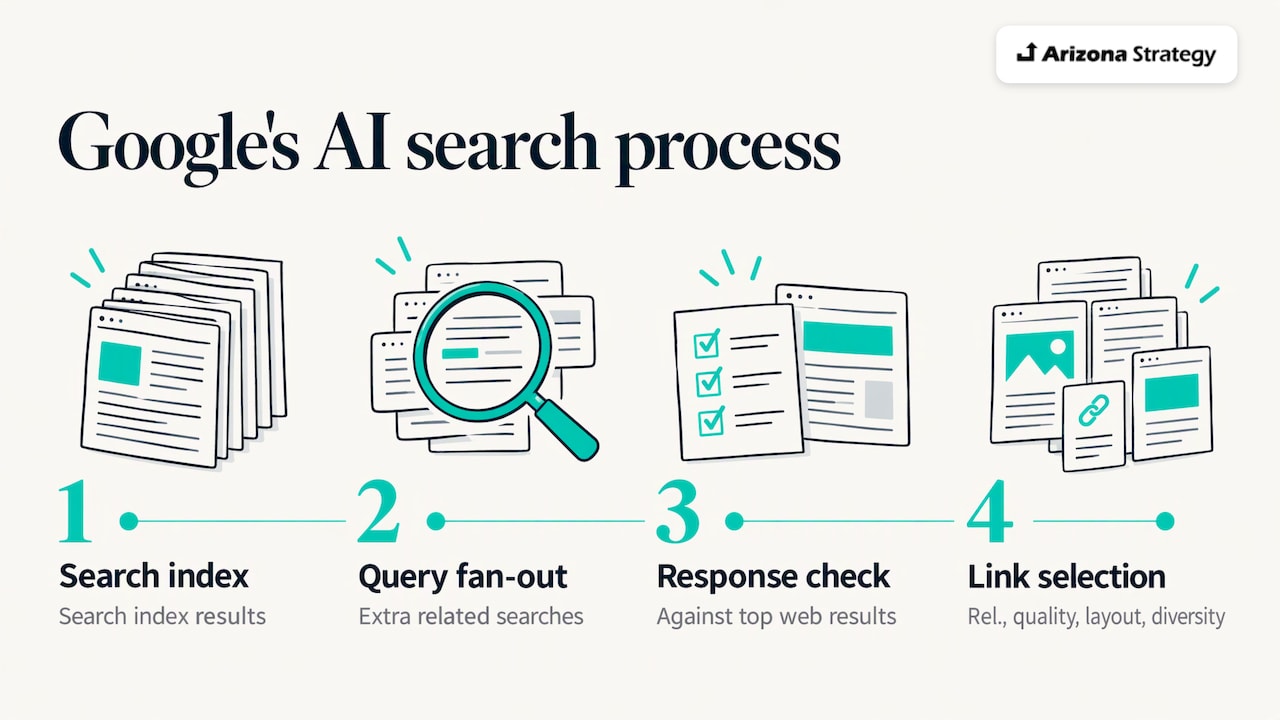
For a plumber in Tempe or a dental office in Chandler, the practical meaning is this: the customer’s question gets broken into several smaller searches, and your page has to be a strong match for one or more of them.
Start with eligibility: the technical checklist
Great copy does nothing if the page cannot be shown. Google’s guide says a page must be indexed and eligible to appear in Search with a snippet, content should be crawlable, JavaScript must not hide the text, pages should load quickly on all devices, and duplicate content should be reduced.
Work through this list on your key service pages:
- Confirm indexing. Check in Google Search Console that each money page is indexed.
- Check the generative AI setting. A site must be included in the Search generative AI control in Search Console to be eligible for AI Overviews and AI Mode. The control does not affect model training.
- Make the text readable by crawlers. The words that answer the question should be in the page’s HTML, not locked inside scripts or images.
- Fix speed and mobile layout. Most local searches happen on phones.
- Remove near-duplicate pages. Ten nearly identical city pages dilute each other.
Google also states that Search does not use an LLMS.txt file or special AI markup, that there is no required page length or chunking, and that structured data is not required for generative AI search, though it still helps with rich results. That saves you from chasing tricks. Spend the time on content and the basics.
For ChatGPT, OpenAI documents a crawler called OAI-SearchBot that surfaces sites in its search features. Allowing it makes a site eligible but does not guarantee a citation, so check that your robots.txt file is not blocking it by accident.
Technical SEO is where many Arizona sites quietly lose ground, and it is a core part of our local and technical SEO work.
Write for the questions behind the question
Each AI answer starts from a customer problem. Content briefs built around that problem outperform briefs built around a keyword. Search Engine Land’s Benu Aggarwal recommends four questions for every brief: what the customer is trying to accomplish, which facts and constraints matter, what evidence you can provide, and what the customer should do next.
Here is how that looks for a Phoenix HVAC company writing about a failing air conditioner:
- Goal: get cooling restored fast and avoid a repeat breakdown.
- Facts and constraints: extreme summer heat, system age, whether repair or replacement makes sense, typical response times.
- Evidence: your own job photos, technician credentials, written pricing ranges, customer reviews.
- Next step: a clear way to book a visit or call.
Find the recurring subtopics
Because AI systems fan one question out into several, you want coverage of the subtopics buyers keep raising. Search Engine Land’s topic cluster guidance suggests mapping a core topic and its subtopics with keyword tools and competitor site structure, mining customer language from Reddit, YouTube comments and your own sales or support notes, running buyers’ questions through AI tools, and then building hub-and-spoke clusters around recurring subtopics rather than a page for every variation.
Your best raw material is already in your inbox and your call log. The questions customers ask before they hire you are the questions an AI assistant is being asked.
Make every section answer-ready
Retrieval systems pull individual passages, not whole pages. That is why the same Search Engine Land piece advises making each key passage understandable by itself: descriptive headings, explicit product and location names, and conditions kept next to the claims they qualify.
A practical pattern for each section:
- A heading that names the question or topic in plain words.
- A one- or two-sentence direct answer.
- The supporting detail: numbers, steps, conditions, exceptions.
- A named location or service where it applies (“in Scottsdale,” “for flat roofs”).
Weak: “Our team offers a wide range of solutions for all your needs.”
Stronger: “A typical Phoenix residential AC replacement takes one to two days, depending on whether ductwork needs changes.” Then state what affects the price and link to the page where the customer can request a quote. Only publish figures you can stand behind, and keep prices and features current, since AI answers can repeat outdated details.
What the research says about what gets cited
Two findings are worth remembering.
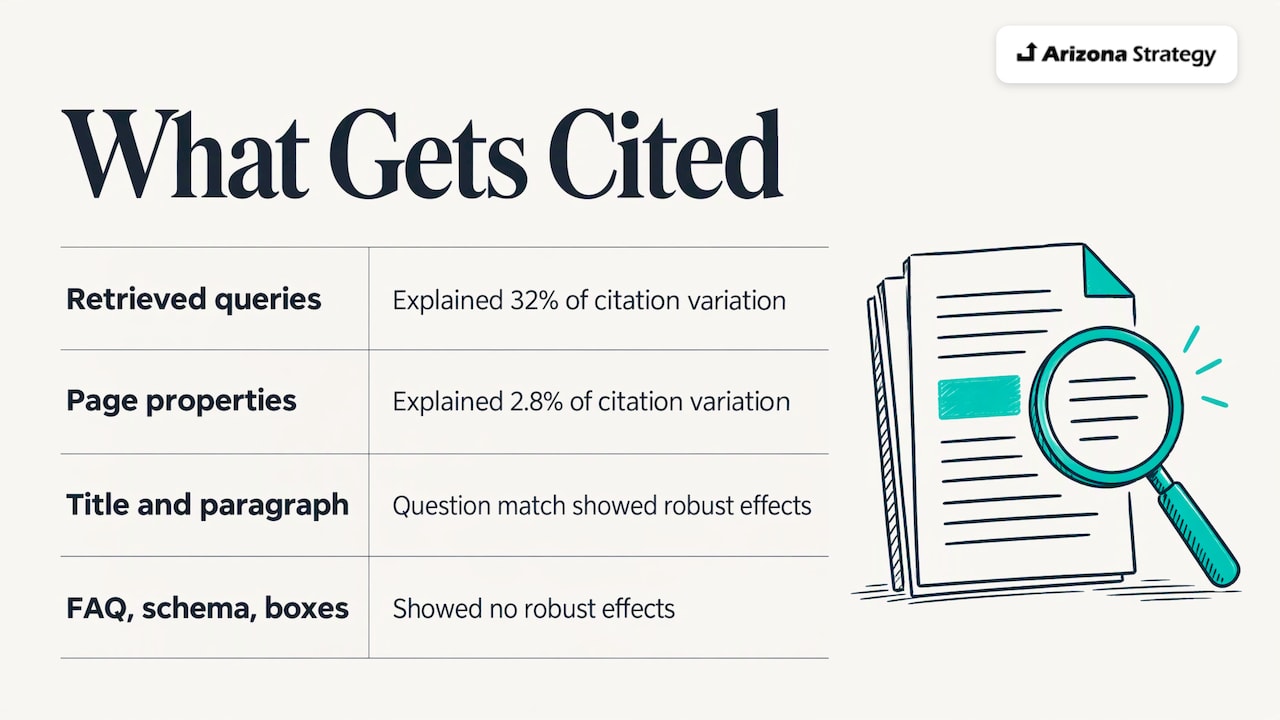
First, a University of Toronto study of 158,099 answers and 468,037 citations from ChatGPT, Gemini and Perplexity found that which pages an engine’s rewritten sub-queries retrieved explained 32% of citation variation, against 2.8% for page properties. Within a site, the title and the best paragraph’s match to the questions people ask showed robust effects, while FAQ blocks, schema markup and summary boxes did not. In plain terms: being retrieved is the main hurdle, and a precise title plus one excellent matching paragraph beats decoration.
Second, Google’s own guidance points to the quality of the content itself. Its perspective is that non-commodity, people-first content with a unique point of view, such as first-hand experience, outperforms recycled summaries because the AI features draw on the same systems as Search.
So add what only you can add: local job examples, your own photos, measurements, the specific way you handle a problem, and the real questions your customers ask.
Local businesses: Google Business Profile and consistency
For local services, AI answers lean on the same signals that drive the Map Pack. Google recommends using Google Business Profiles and Merchant Center feeds so local business details and products can appear in AI responses.
A local checklist:
- Business name, address, phone and hours match across your website, profile and directories.
- The website field on your Business Profile points to your own site.
- Service areas and categories reflect what you actually do in Phoenix, Mesa, Gilbert or wherever you work.
- Each service page names the city or neighborhood it covers.
- Reviews arrive steadily and get answered.
On the website field, a Localo analysis of 1,066 matched sites found that those linked from the Business Profile gained a median 76% in AI impressions, while sites whose profile linked elsewhere lost a median 9%. It is one company’s sample, so treat it as a direction rather than a guarantee, but fixing a wrong link costs nothing.
Reviews are part of this picture too. Our Google Review Growth by RankStream service is built to help businesses collect more Google reviews, which keeps the profile active and fresh.
Update old content instead of only publishing new
Most sites already have pages that almost answer the question. Refreshing them is faster than starting over. Use a simple decision for each page: keep, refresh, rewrite, merge, redirect or retire. Update a page when it becomes a better answer, not just to change a date.
A quick refresh routine:
- Move the direct answer to the top of the page.
- Split long blocks into sections with descriptive headings.
- Replace stale facts, prices and screenshots.
- Add original evidence: a recent project, a photo, a number from your own records.
- Link related pages together so the cluster is obvious.
- Recheck indexing in Search Console after publishing.
Write down what you changed so you can compare results after a few weeks.
Fix the page people land on
Visibility only pays when the visitor takes action. A page that earns an AI citation but buries the phone number or booking form wastes the click. Make sure the page states what you do, where you do it, what happens next, and offers a short form or click-to-call button that works on mobile. This is the work behind our web design and conversion optimization service.
Measuring AI visibility honestly
Expect noise. Google warns that no third-party tool has access to its internal ranking or AI systems, and that meeting every requirement does not guarantee a page will be crawled, indexed or shown. Citations also move: in a small study of 100 queries reported by Search Engine Land, 45% of pages cited in AI Overviews appeared only once over several days.
That makes single-day snapshots misleading. A better scorecard for a local business:
| What to track | Where | How often |
|---|---|---|
| Indexed pages and search impressions | Search Console | Weekly |
| Profile views, calls, direction requests | Google Business Profile | Monthly |
| Form fills, calls and booked jobs from organic visits | Analytics and call tracking | Monthly |
| Whether your business is mentioned for a fixed set of 15 to 25 customer questions | Manual checks in AI tools | Monthly, same questions each time |
The last column of outcomes matters most: qualified leads and booked appointments, not mentions alone.
Where Arizona Strategy fits
If you would rather not run this yourself, our AI Mentions service focuses on getting your business mentioned in AI platforms such as ChatGPT, Gemini and Perplexity, while our Local & Technical SEO service handles the foundation those answers depend on: crawlability, local signals, content and backlinks. Our AI visibility services guide explains what such work includes, and our article on improving AI search visibility for Arizona businesses goes deeper on the local side.
Promo: AI visibility and lead follow-up in one place
Arizona Strategy is a Phoenix-based agency serving small and midsize businesses in Phoenix, Scottsdale, Tempe, Mesa, Chandler and across Arizona. We combine local and technical SEO, AI Mentions, conversion-focused web design, Google Ads management and review growth, and our AI Marketing Automation service, listed at $100 per month, handles intelligent SMS and email follow-ups so new leads do not go cold.

See the full list of services on our website and tell us which customer questions you want your business to answer.
Perspective
Most owners ask us whether AI search needs a separate strategy. Our view: it needs a stronger version of the one you should already have. The same pages that rank in Google Search and Google Maps are the ones the AI platforms find, so we start with technical health, local accuracy and content that answers real customer questions.
We also judge the work by business outcomes, not by impressions. A mention in ChatGPT matters when it leads to a call, a booked appointment or a paying customer. That is why we connect visibility work with conversion-focused websites, review growth and automated follow-up.
Our goal is to give local businesses the marketing capabilities of larger competitors without enterprise-level costs, and AI search is the place where a well-run Arizona business can show up next to the national names.
Jeff Hamilton
FAQ
Is optimizing for AI search different from SEO?
Mostly it builds on SEO. Google states that its AI features rely on core Search ranking and quality systems, so indexing, helpful content and site quality still decide eligibility. The differences are in how you write: answer-first sections, specific facts and passages that stand alone.
Do I need schema markup or an LLMS.txt file?
Google says Search does not use LLMS.txt or special AI markup, and structured data is not required for generative AI search. Structured data still supports rich results, so it can be worth adding where it fits, but content quality and technical eligibility come first.
How long does it take to appear in AI answers?
There is no fixed timeline, and Google says even a page that meets every requirement is not guaranteed to be served in AI features. Changes must be crawled and indexed first, and citations vary between runs, so review progress monthly over a consistent set of questions.
What should a local business fix first?
Start with indexing and your Google Business Profile: confirm key pages are indexed, the profile’s website field points to your site, and your name, address and phone number match everywhere. Then rewrite your top service pages so each opens with a direct answer and names the cities you serve.
Sources
- Google’s Guide to Optimizing for Generative AI Features on Google Search
- Attribution and Factuality in Search Generative AI Features
- Control How Your Content Is Used for Generative AI at Google Search
- What Drives AI Citations? Content, Retrieval and Model
- How to build topic clusters for SEO and AI search
- How to build a content intelligence strategy for AI search
- AI Overviews changed what content needs to do
- Local Business Websites in Google’s AI Answers