SEO Competitor Analysis for Phoenix Businesses: A Practical Guide
SEO Competitor Analysis for Phoenix Businesses: A Practical Guide

An SEO competitor analysis shows you who is winning the searches your customers type, why they are winning, and which gaps you can close first. For a Phoenix, Scottsdale, Tempe, Mesa or Chandler business, the work has three layers: the Google Maps pack, the regular organic results, and the AI answers in ChatGPT, Gemini and Google. Done well, it ends in a short, ordered list of fixes, not a spreadsheet nobody reads. This guide walks through each layer, shows where it goes wrong, and explains where Arizona Strategy’s local and technical SEO work takes the heavy lifting off an owner’s desk.
TL;DR
- Your SEO competitors are whoever ranks for your customers’ searches, not only the businesses you compete with offline.
- Start with 3 to 5 real rivals, found by searching your own money keywords from the neighborhoods you serve.
- Compare four things: Google Business Profile and reviews, keywords and content, backlinks and citations, and technical health.
- Check which competitors show up in AI answers when you do not, then look at the pages those answers lean on.
- Turn findings into a 60-day plan: quick wins first, bigger projects second, noise last.
Table of Contents
- What an SEO competitor analysis actually is
- Step 1: Find the competitors Google actually sees
- Step 2: Compare Google Maps and local visibility
- Step 3: Compare keywords and content
- Step 4: Compare backlinks and citations
- Step 5: Check technical health
- Step 6: See who appears in AI answers
- Step 7: Turn findings into a 60-day plan
- What this looks like with a Phoenix agency
- Our perspective
- FAQ
- Sources
What an SEO competitor analysis actually is
It is a structured look at how other sites earn their rankings so you can decide where to compete. You are collecting evidence on what works in your market, where rivals are weak, and which tasks deserve priority. Ahrefs, an SEO software company, describes the goal as finding rivals’ strengths and weaknesses so you can outrank them.
The important word is decide. The point is not to copy a competitor. Anyone who rebuilds a rival’s pages line by line ends up with a weaker version of something that already exists. The useful question is why a tactic works and where your business can offer something different: a service area you know better, a faster response time, a more specific page for the job the customer wants done.
When it pays off most
Run one when you launch or redesign a website, when you are planning a year of SEO work, when a competitor suddenly outranks you, or when your own rankings drop. A drop after a Google algorithm update is a particularly good trigger: Search Engine Land’s guide to competitor analysis for SEO and AI search recommends recurring competitor reviews plus a dedicated one after major updates.
Step 1: Find the competitors Google actually sees
Your SEO competitors are the sites that rank for the queries you want. HubSpot’s guide makes the same point: they are whoever appears for those searches, whether or not they sell what you sell. Search Engine Journal’s local competitor analysis guide adds that large retailers, directories and industry sites often compete for local visibility alongside the shop down the street.
That explains a common surprise. A Phoenix roofing company may think its rivals are the other three roofers in the area, then discover that a lead-generation directory and a national home-services site hold most of the page-one space.
How to build the list
- Write down 5 to 10 searches that bring you paying customers, such as “AC repair Tempe” or “estate planning attorney Scottsdale.” Use the words customers use, not your industry’s.
- Search each one and note which businesses appear in the Maps pack (the three map listings Google shows at the top for local searches) and in the organic results below it.
- Record the query, the type of result (map or organic), the position, the search location and how often each business reappears.
- Keep the 3 to 5 names that show up most often. A short list is easier to study properly than a long one.
Businesses that appear in both the Maps pack and the organic results for local queries are your truest local rivals.
Where it goes wrong
Location changes everything. Someone searching from downtown Phoenix sees different map results than someone in Gilbert, because proximity and personalization shape local results. If you search once from your office and treat the result as fact, you have measured one spot on a map. Repeat the search from the areas where your customers actually live and note the differences. Most owners stop after one search. Arizona Strategy’s local SEO work is built around this problem: rankings vary block by block, so the comparison has to be made across the service area, not from a single laptop.
Step 2: Compare Google Maps and local visibility
For a service business, Maps is often where the call or visit begins. Google picks local results mainly on three factors: relevance (how well the listing matches the search), distance (how close it is to the searcher) and prominence (how well known and trusted the business appears). You cannot change distance, so the comparison focuses on relevance and prominence.
Open the Google Business Profile of each top competitor and record:
- Primary and secondary categories. The category is one of the strongest relevance signals. A competitor ranking above you may simply have chosen a more precise one.
- Description, services and attributes. Are services listed individually or left blank?
- Photos, videos and posts. How many, how recent, and how often they post.
- Q&A activity. Whether questions are answered or ignored.
- Reviews. Total count, average rating, how recent the newest ones are, and whether the owner replies.
- Name, address and phone consistency. Listings that match across the web are easier for Google to trust.
These are the same elements Search Engine Journal lists for a local comparison.
Read the reviews for language, not only stars
Reviews tell you what customers care about, in their own words. If a competitor’s reviews keep mentioning “same-day,” “showed up on time” or “explained the price,” those phrases belong in your service pages and your own review requests. Repeated customer phrasing is also a source of local keywords you would never guess from a tool.
What this means in practice
If competitors have 300 reviews and you have 40, no category tweak will close that gap quickly. That is a review-volume project. Arizona Strategy’s Google Review Growth by RankStream is built for exactly this, and a steady flow of recent reviews is the kind of prominence signal the comparison exposes. For the details of what moves Phoenix map rankings in one industry, see our read of Map pack signals for home services.
Step 3: Compare keywords and content
Now move to the organic results. A keyword gap analysis lists the searches your competitors rank for and you do not. Search Engine Land’s gap analysis guide separates these into types:
| Gap type | What it means | What to do |
|---|---|---|
| Missing | They rank, you have no page | Build a page |
| Weak | You rank low, they rank high | Improve and expand your page |
| Shared | Both rank | Defend, or push higher |
| Untapped | Nobody serves it well | Move first |
| Unique | Only you rank | Protect and build on it |
Group the gaps by topic and by intent. Intent is what the searcher wants: to learn something, to compare options, or to hire someone now. A person typing “how much does a new roof cost” and a person typing “roofing contractor Mesa” need different pages. If Google shows only service pages for a query, a blog post will rarely break in, and the reverse is also true. Read the top results before you decide what to write.
Study the page, not just the keyword
Look at each strong competitor page and note the title, headings, how it handles neighborhood or city names, whether it has structured data (code that labels the page’s content for search engines), and how it behaves on a phone. Many Arizona searches happen on mobile, often by someone standing in a hot driveway, so a slow or cluttered phone page costs real calls.
Keep the lesson separate from the layout. What is the audience angle? Is there original data, a price range, a photo of real work, a license number? Those are trust signals, and they are what you copy in spirit, never in wording.
Where it goes wrong
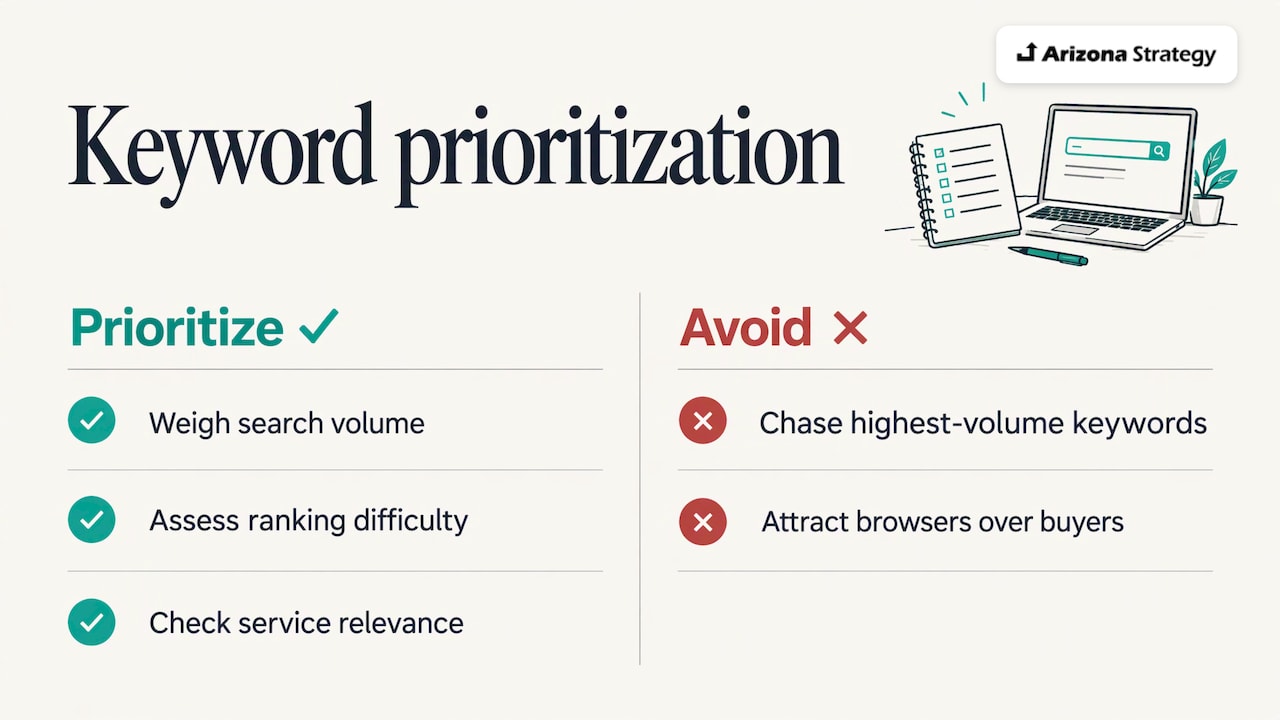
The usual mistake is chasing the highest-volume keyword. Rank by three things instead: volume, difficulty and relevance to a service you want to sell. A phrase with 50 monthly searches that matches your most profitable job beats a phrase with 5,000 that attracts browsers. If traffic arrives but the page does not turn it into calls, the gap is conversion, not ranking, which is a website design question. That is where Phoenix web design and conversion optimization comes in.
Step 4: Compare backlinks and citations
Backlinks are links from other websites to yours. They signal that others vouch for you. Citations are mentions of your business name, address and phone number on directories and local sites. Compare both:
- Which sites link to your top competitors but not to you? Local news, chambers of commerce, suppliers, trade associations and sponsorships are common sources.
- Are there directories where competitors are listed and you are missing, or listed with an old address?
- Do competitors’ links point to service pages or only to the home page?
Sort the results by effort. A missing directory listing is an afternoon. A feature in a local publication is a relationship. Pursue relevant links, not any link: one from a Phoenix trade group is worth more than ten from unrelated sites. If you want to understand citations in more depth, our articles on local citations cover how they work.
Step 5: Check technical health
Technical SEO means the behind-the-scenes condition of a site: how fast it loads, whether Google can crawl it, whether pages are duplicated, whether the mobile version works. A competitor with average content can still outrank a better page if its site is clean and yours is slow or broken.
Compare the basics side by side: page speed on mobile, whether every page uses a secure connection, whether location and service pages have unique titles, and whether structured data is present. Technical findings often look dull next to content ideas, yet they are frequently the quickest wins because the fix is a one-time job. If you want a full review, the technical SEO audit work at Arizona Strategy is where this check gets done for you.
Step 6: See who appears in AI answers
Buyers now ask ChatGPT, Gemini, Perplexity and Google’s AI features for recommendations before they ever open a map. The competitor question changes: when someone asks “who is the best electrician in Chandler?”, which businesses are named, and which sources does the AI lean on?
A practical routine:
- Write 10 to 15 prompts a real customer would use, including your city or neighborhood.
- Run the same prompts on each AI platform and log which businesses are mentioned and which pages are cited.
- Mark the prompts where a competitor appears and you do not.
- Open the pages being cited. They may be a competitor’s own service page, a review site, a local article, a forum thread or a video.
- Match your response to the source type: improve your page, earn a mention on the cited site, or publish something that answers the question better.
Examine what the cited pages do well: clear structure, direct answers near the top, original data, visible trust signals. Repeat the prompts regularly, because AI answers shift. Arizona Strategy’s AI Mentions service and its AI search optimization (GEO and AEO, meaning optimization for generative and answer engines) are aimed at exactly this visibility, and our AI search optimization articles go deeper.
Step 7: Turn findings into a 60-day plan
An analysis that ends in a 40-row spreadsheet changes nothing. Sort every finding into three groups:
- Quick wins: high impact, low effort. Examples: fixing a wrong Google Business Profile category, correcting inconsistent phone numbers, adding missing service pages’ titles, asking recent customers for reviews.
- Bigger projects: high impact, more effort. Examples: a new set of city or service pages, a link-building campaign, a site rebuild for speed and conversion.
- Noise: low impact. Set it aside, even if a competitor does it.
Search Engine Land’s guidance is to tie each action to a specific gap, give it an owner and a deadline, and commit to a small set of actions inside 60 days. Search Engine Journal’s advice is similar in spirit: use the evidence to find where you can build a position of strength, not where you have little authority.
Measure what matters
Rankings alone are an incomplete scorecard. Track calls, direction requests and form fills from your Google Business Profile and website, alongside Maps rankings in the areas you serve and visibility in AI answers. The question is whether the change produces booked appointments and paying customers, which is how Arizona Strategy frames its own work.
What this looks like with a Phoenix agency
Doing this properly takes real hours: repeated searches from several locations, profile audits, gap lists, link research, AI prompt logging, and then the work of fixing what you find. For a small business owner those hours come out of running the business.
Arizona Strategy is a Phoenix-based agency that serves small and midsize businesses in Phoenix, Scottsdale, Tempe, Mesa, Chandler and the wider state. Our Local & Technical SEO covers the Maps and organic side, Google Review Growth by RankStream builds the review base, Web Design & CRO turns visits into inquiries, and AI Mentions targets visibility in ChatGPT, Gemini and Perplexity. Competitor findings flow straight into that work rather than into a report.

If you would like the competitor picture for your market turned into an ordered plan, start at Arizona Strategy and tell us the services and cities you want to win.
Our perspective
Most competitor reports fail at the same place: they describe, then stop. A business owner does not need to know that a rival has 412 reviews. They need to know what that means for next month’s calls and what to do about it.
We start from outcomes. In Phoenix, a plumber in Tempe and a family law firm in Scottsdale face different competitors, different search behavior and different review expectations, so the analysis has to be local from the first search. We look at the Maps pack, organic results and AI answers together, because customers move between them without thinking about it.
Our aim is to give local businesses the marketing capabilities of larger competitors without enterprise costs. A competitor analysis is where that starts: it shows which gaps a smaller business can close fastest, then connects them to the work that closes them, whether that is profile optimization, technical fixes, a conversion-focused website or review generation.
Study competitors to find your own position, never to imitate theirs.
Jeff Hamilton
FAQ
What is the difference between SEO competitors and business competitors?
Business competitors sell what you sell. SEO competitors are any sites ranking for the searches you want, which can include directories, national brands and publishers. For a local business, the list that matters is whoever appears in the Maps pack and the organic results for your service searches.
How many competitors should I analyze?
Three to five is a manageable start. That is enough to see patterns without drowning in data. Pick the ones that appear most often across your priority searches and across the neighborhoods you serve.
How often should I repeat the analysis?
Review your main competitors on a regular schedule, such as quarterly, and run a fresh analysis after a major Google algorithm update or whenever your rankings or calls drop. AI answer checks are worth repeating more often because results shift.
Does competitor analysis work for AI search like ChatGPT and Gemini?
Yes. Run the same customer-style prompts on each platform, log which businesses and pages are named, and find the prompts where rivals appear and you do not. Then improve or create content, or earn mentions on the sources being cited.
Sources
- Competitor Analysis In Local SEO And How To Gain An Edge, Search Engine Journal
- SEO gap analysis: Find content and keyword gaps, Search Engine Land
- How to conduct an AI search and SEO competitor analysis, Search Engine Land